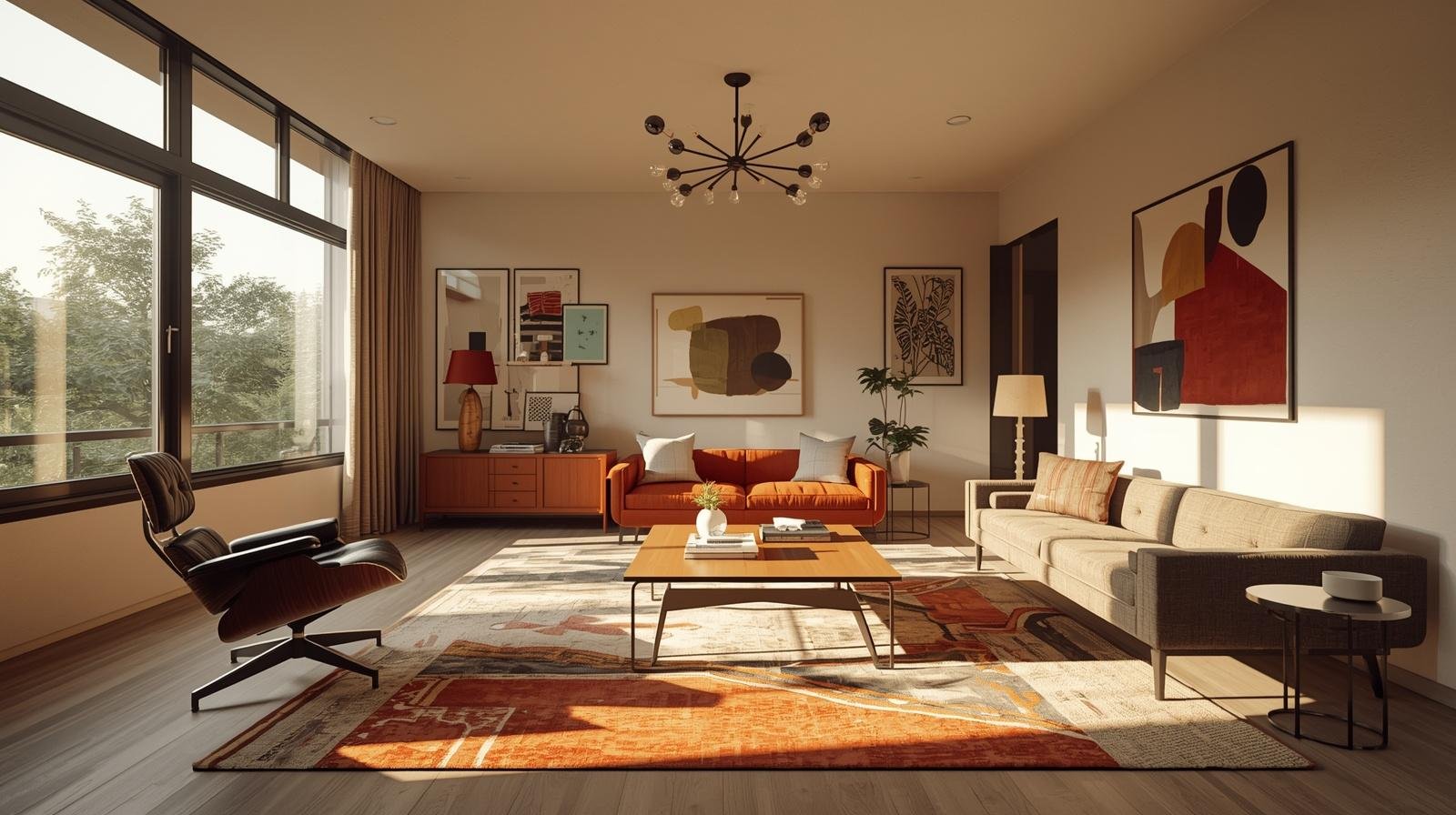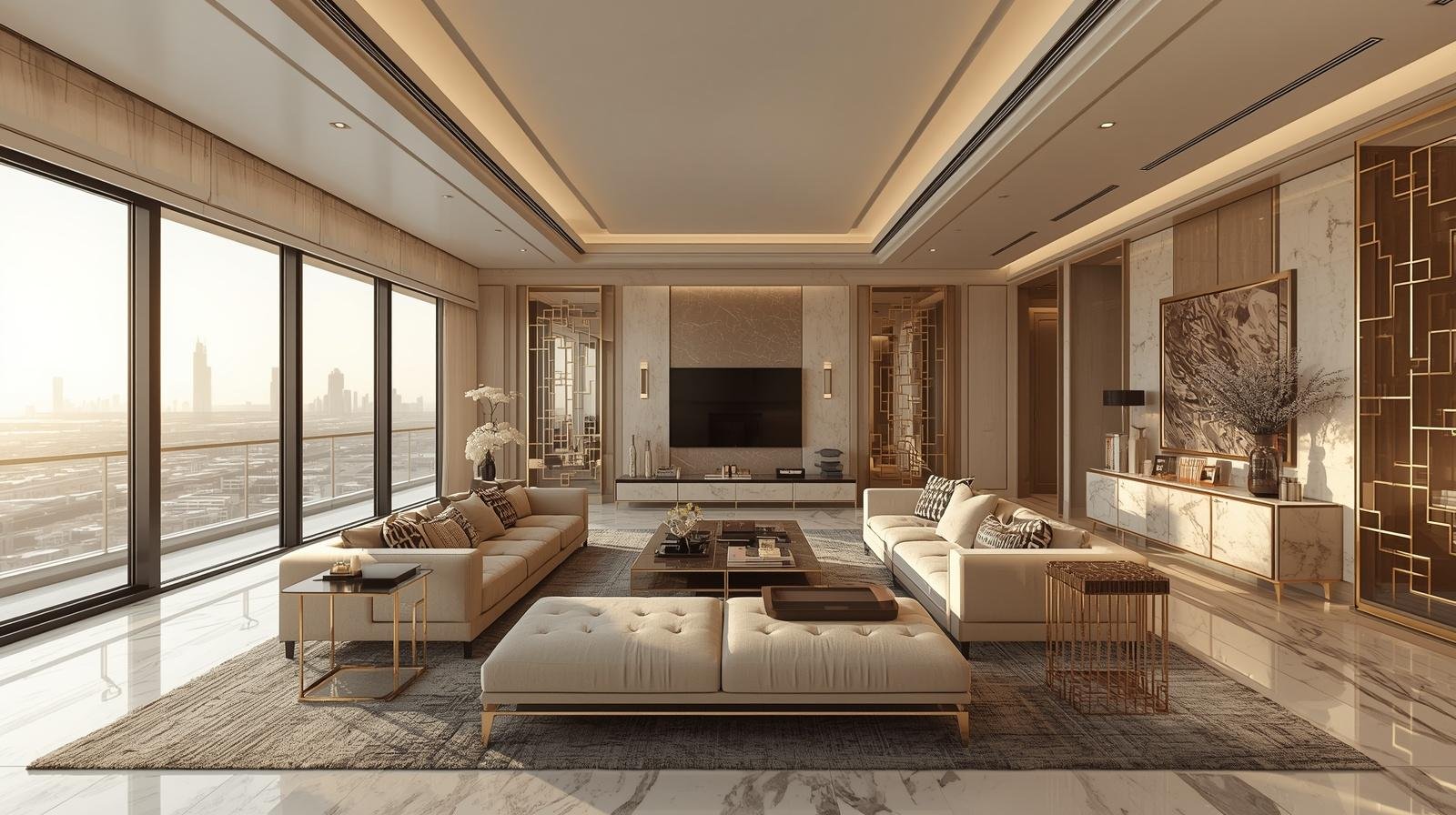
A 3,800 sq ft apartment where Indian craftsmanship meets Gulf luxury—creating a transcontinental dialogue through custom brass work, handwoven textiles, and contemporary spatial planning.
The clients—a Dubai-based entrepreneur originally from Mumbai and his Emirati wife—approached us seeking something rare in Dubai's luxury residential market: a space that honored both their heritages without resorting to obvious cultural signifiers. They had lived in the Marina tower's developer-finished apartment for two years, comfortable but unattached. What they sought was transformation: from generic luxury into something unmistakably theirs.
Their brief emphasized restraint. No Mughal arches, no Arabic calligraphy, no folksy Rajasthani murals. Instead, they wanted the synthesis to happen through materials, craft, and spatial sensibility—elements that would feel contemporary and international while carrying cultural memory in their making. The husband collected vintage photographs of Bombay; the wife, an accomplished calligrapher, needed dedicated studio space. Both traveled constantly for work and wanted the apartment to feel like sanctuary upon return.
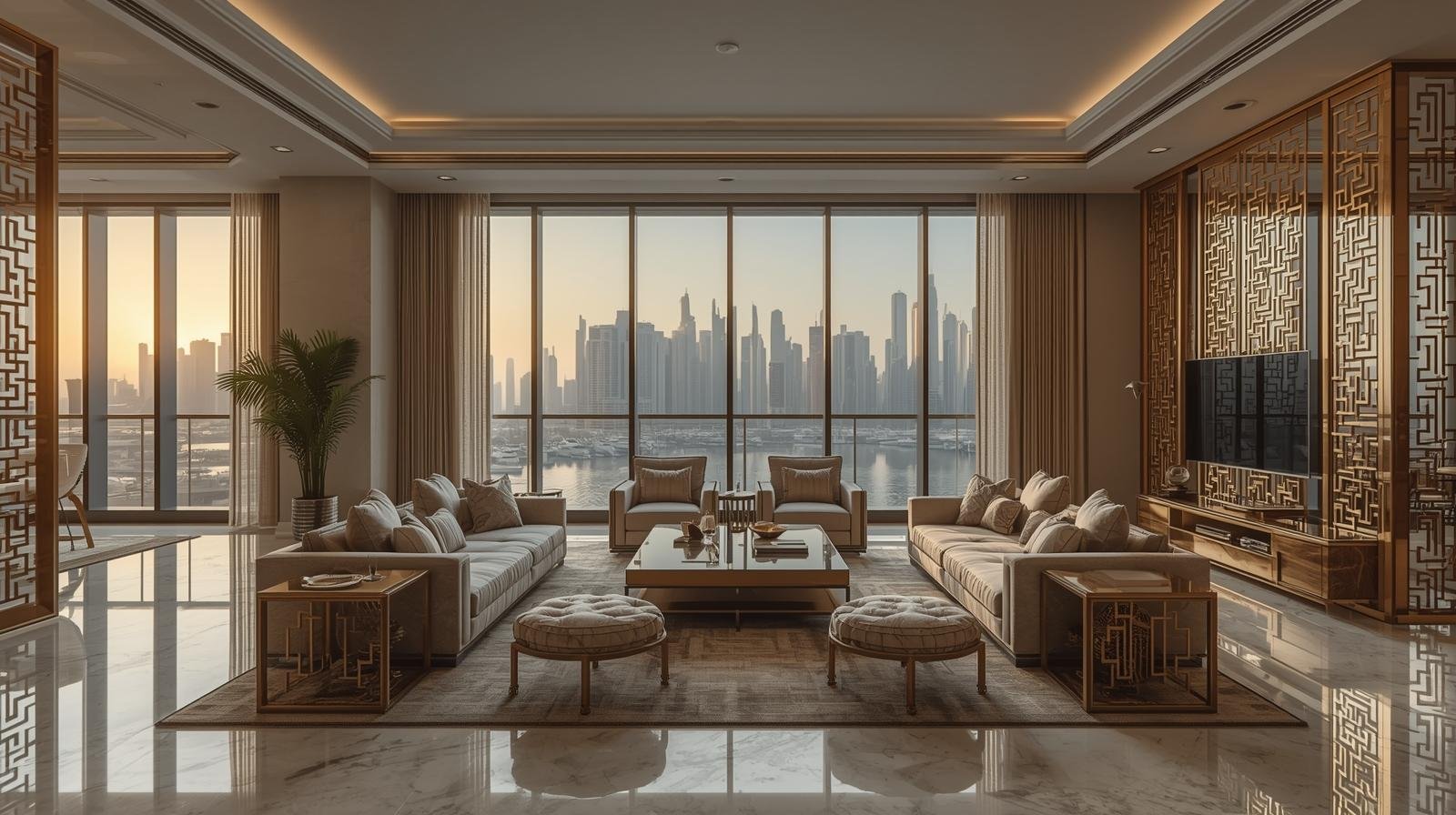
Dubai's residential high-rises present specific challenges. The views—spectacular panoramas of marina, sea, and city—compete for attention, making every design gesture feel either inadequate or excessive. The typical response is to minimize interiors, treating them as mere viewing platforms. We chose differently: to create spaces rich enough to hold their own against the view while maintaining visual quietude.
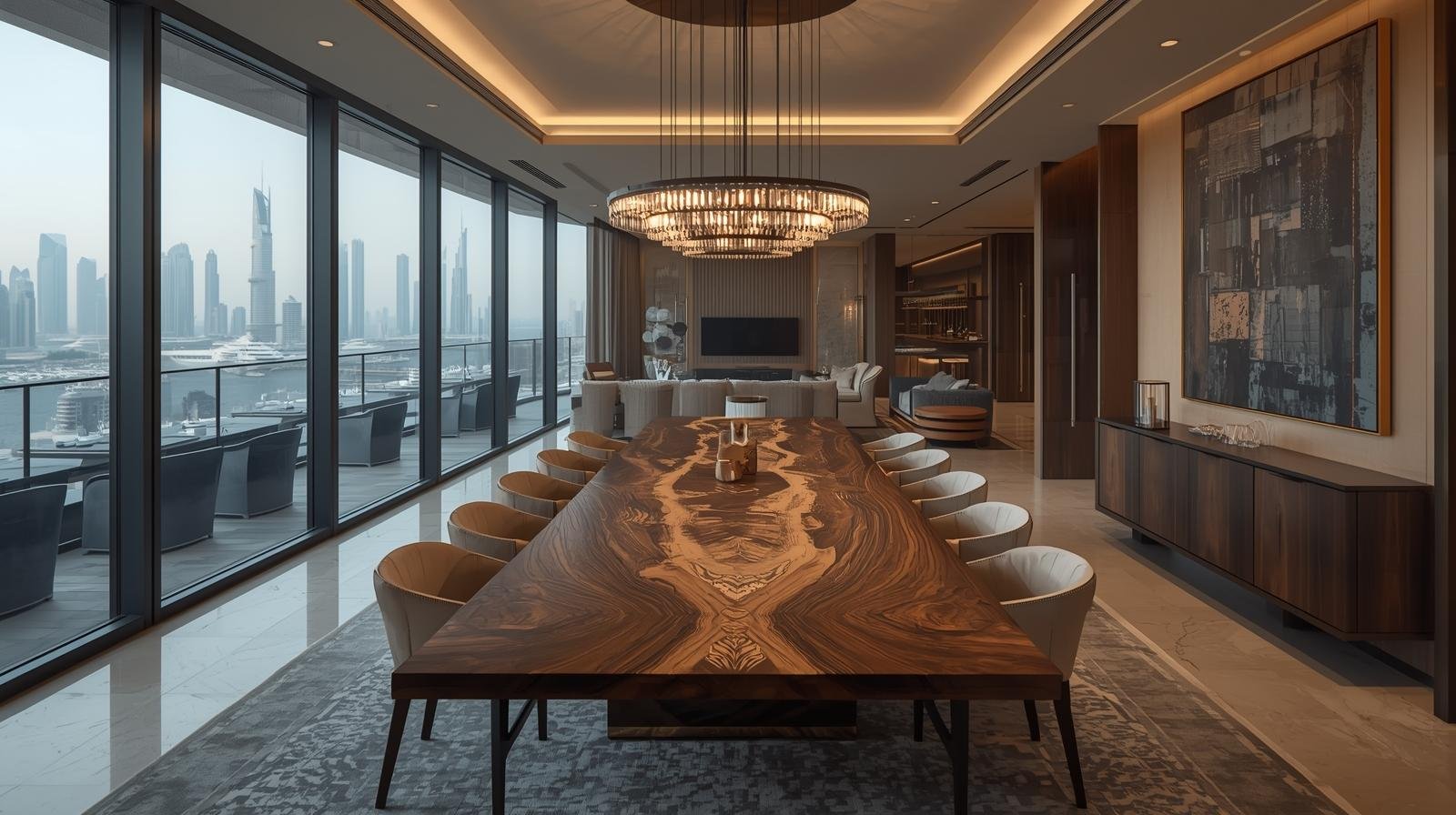
The plan reorganization became crucial. Developer layouts prioritize bedroom count over spatial quality. We eliminated a redundant bedroom, creating instead a flowing sequence of interconnected spaces: entry gallery, formal living, library, dining, and the calligraphy studio. Each room offers distinct character while maintaining visual continuity through material palette and ceiling detail.
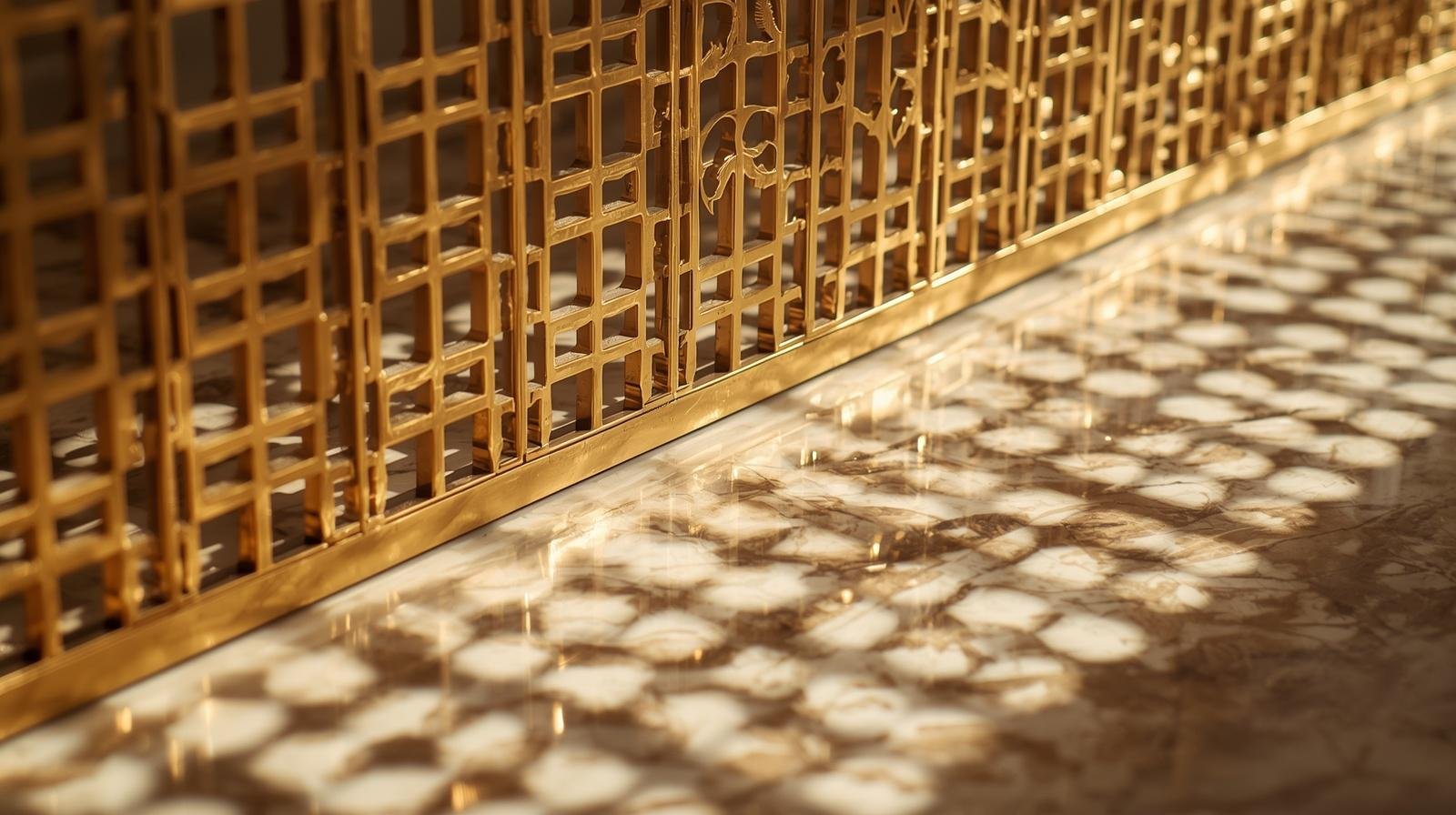
The brass screens represent eight months of collaboration between our atelier and artisans in Moradabad. We sent them historic photographs of traditional jali work, asking them to abstract the patterns into contemporary geometry. The result: perforated brass panels that reference heritage without replicating it. Installed floor-to-ceiling at key thresholds, they create layers—spaces visible but distinct, connected but defined. As Dubai's intense sun moves across the apartment, the screens cast geometric shadows that animate walls and floors.
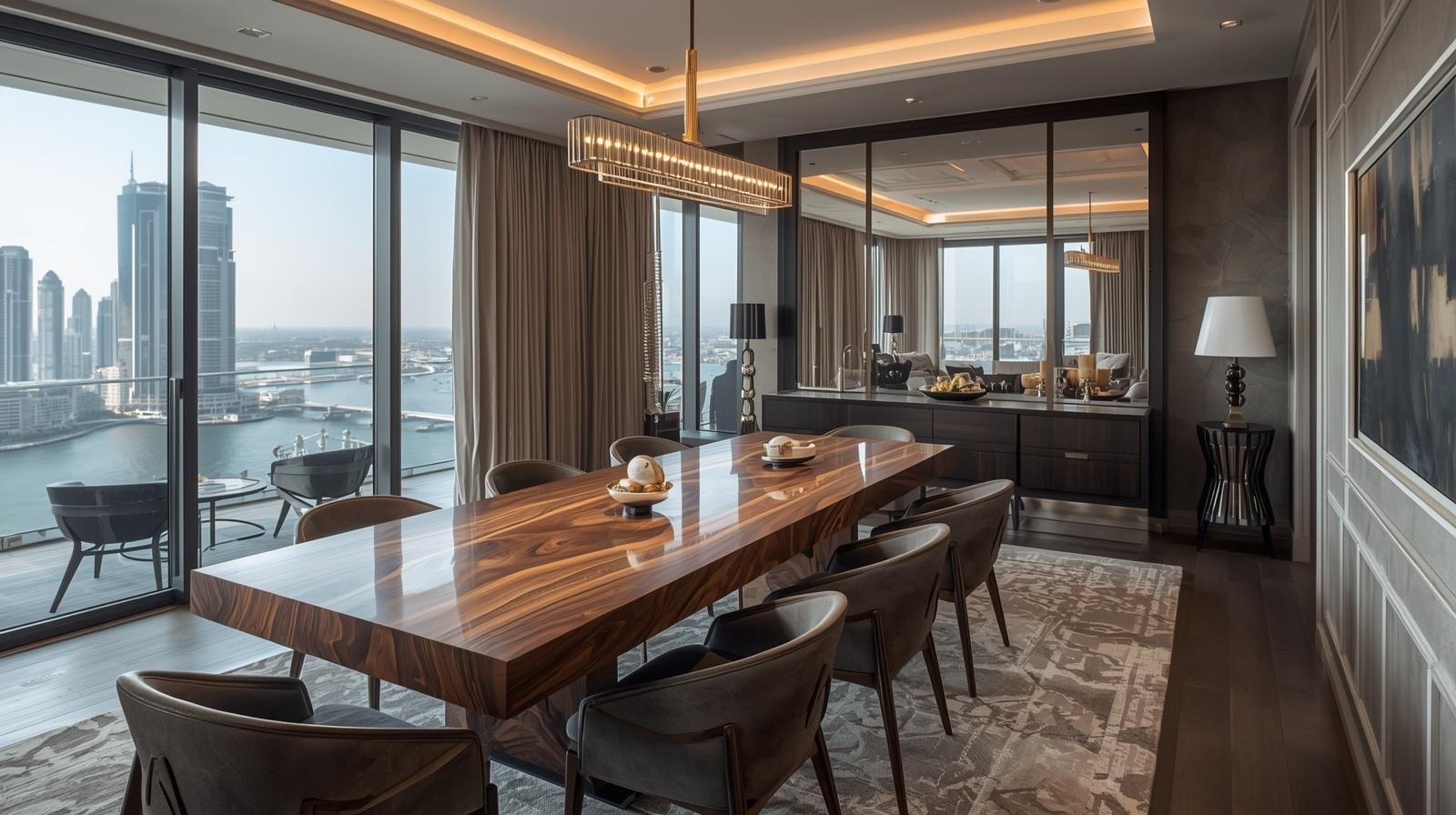
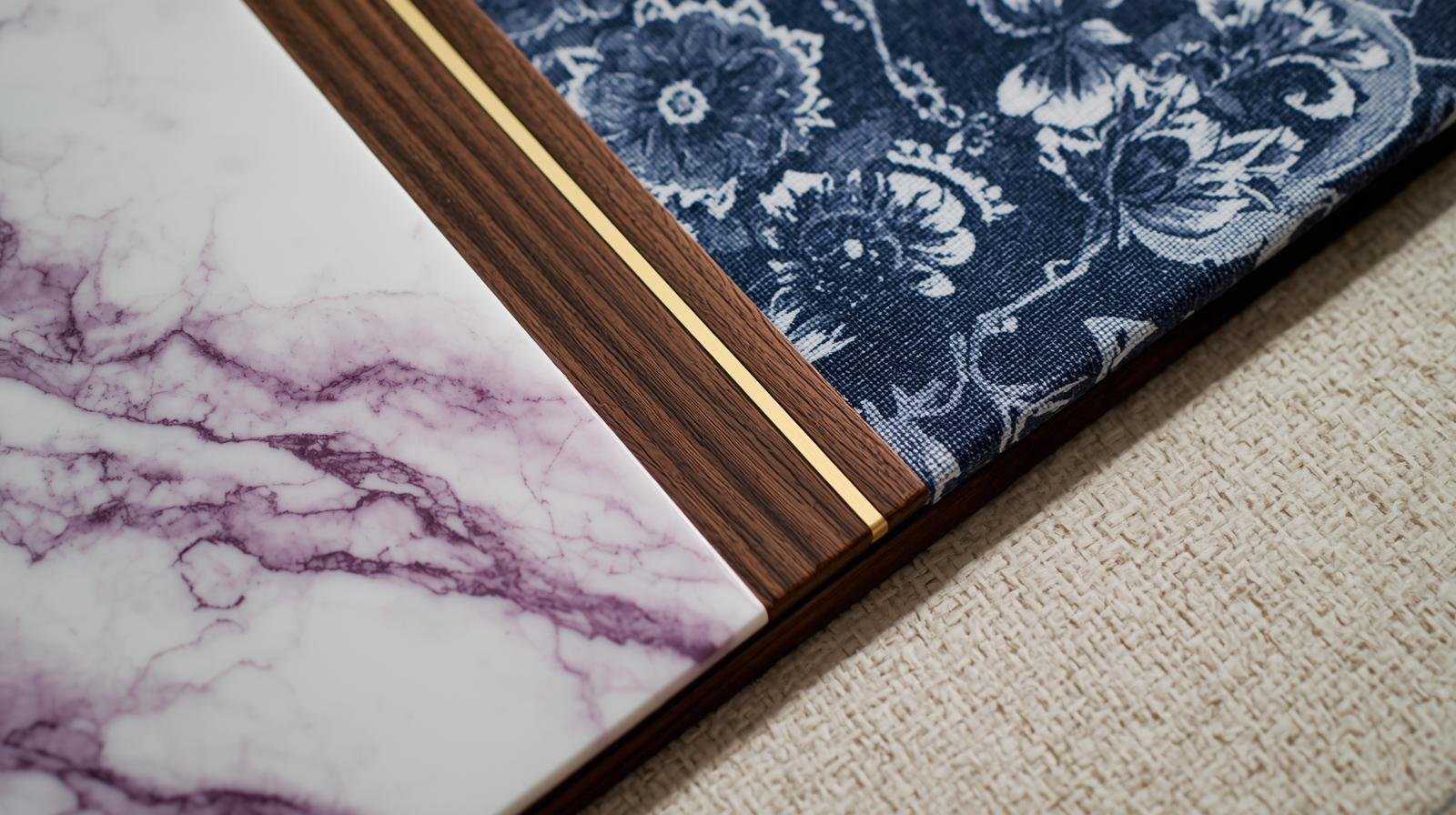
Material choices balanced opulence with understatement. Calacatta Viola marble—quarried in Italy, cut and installed by Indian stone specialists in Dubai—floors the entry and primary living area. Its dramatic purple veining provides singular focal moment. Elsewhere, we employed wide-plank European oak, finished with white oil to maintain lightness. All millwork uses American walnut with brass inlay details—patterns inspired by Islamic geometric traditions but executed through contemporary CNC precision.
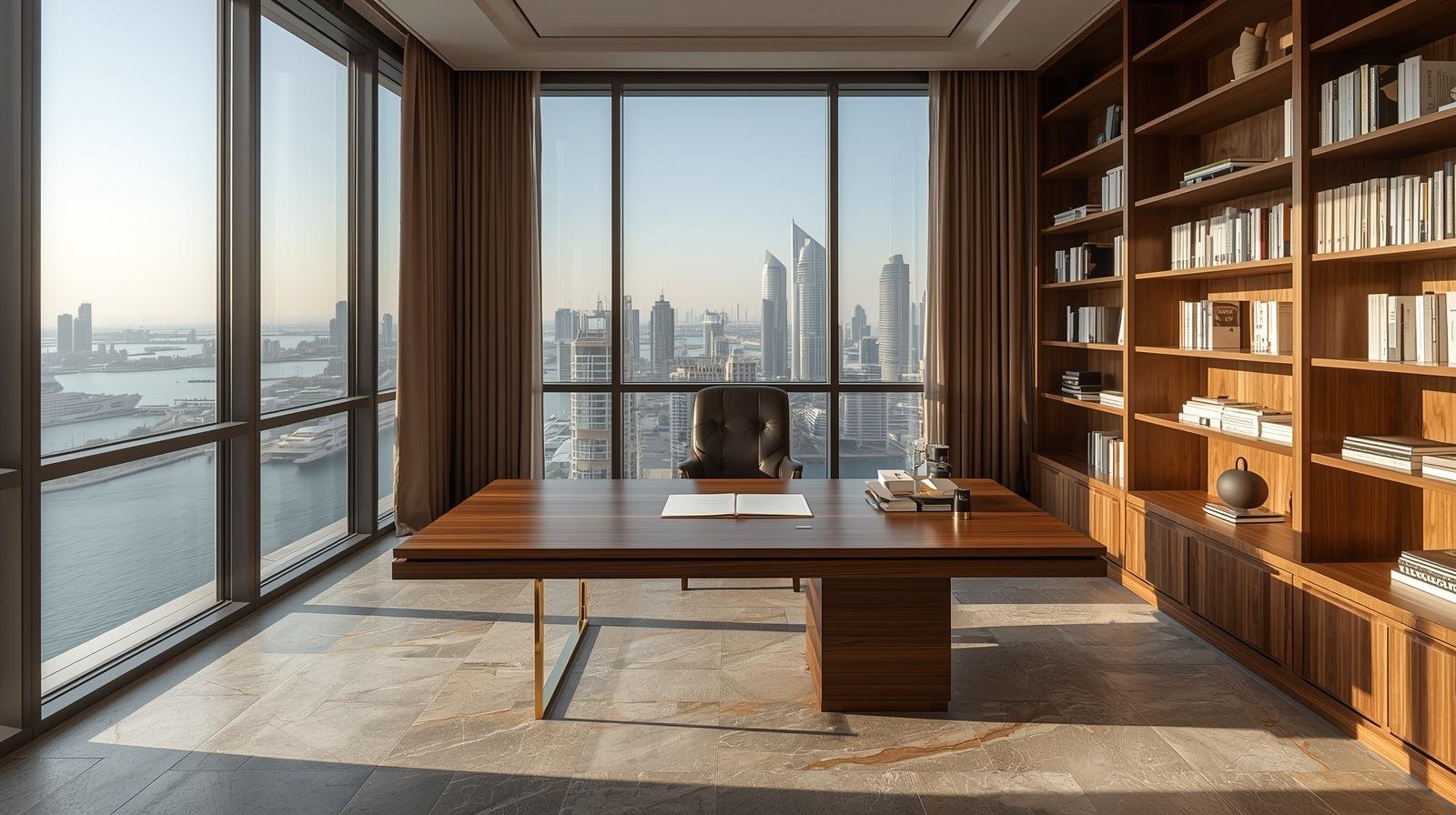
The calligraphy studio became the project's conceptual heart. Located at the apartment's eastern corner to capture morning light, the room features floor-to-ceiling windows facing the marina. The floor, unlike the rest of the apartment, uses traditional Indian kotah stone—its cool surface a deliberate contrast to wood and marble elsewhere, grounding the contemplative practice.
The calligraphy studio represents the project's quietest luxury—a room designed for single use, for one person, for focused practice. In Dubai's culture of ostentation, this felt radical: dedicating premium square footage to contemplation rather than display.
The room's material palette deliberately contrasts the apartment's elsewhere. Where other spaces employ marble and walnut, here kotah stone grounds the floor—its green-grey tones cool and meditative. The walls, rather than elaborate millwork, receive simple lime plaster in warm white. Only the desk—that floating walnut and brass composition—introduces ornamentation, and even that remains understated.
Storage was conceived as display. Open shelving in walnut houses the wife's collection of inks, papers, and vintage pens. Each object becomes small sculpture against the wood's grain. Books on calligraphy, Islamic art, and Indian miniature painting fill one wall. The room feels simultaneously library, studio, and sanctuary.
Light came from multiple sources. Morning sun provides natural illumination for detailed work. Task lighting—a custom brass lamp designed specifically for this desk—offers focused light in evening. Ambient illumination comes from concealed LEDs in the ceiling cove, creating even glow without glare. The room can shift from bright workspace to meditative retreat depending on need.
"Living in Dubai, we're surrounded by luxury—but it often feels hollow, purchased rather than created. Crosby gave us something different: a home that carries stories in its materials, where every detail was made by someone's hands. It reminds us daily of our roots while embracing where we live now."— Zara & Aditya Kapoor, Homeowners
Hand-cut brass, contemporary geometry
The screens represent eight months of iteration. Our atelier developed digital drawings based on traditional jali patterns, then worked with Moradabad artisans to translate geometry into brass. Each panel—measuring 10 feet tall—was cut from 4mm brass sheet using water-jet technology, then hand-finished to remove burrs. The brass was chemically patinated to achieve warm golden tone, then sealed. Installation required custom floor-to-ceiling frames designed to accommodate Dubai's seismic requirements.
Saharanpur carpentry, traditional joinery
All tables were commissioned from Master Carpenter Rajesh Kumar, whose family has worked wood for four generations. The sal and sheesham—both indigenous hardwoods—were sourced from responsibly managed forests, then air-dried for six months. Traditional mortise-and-tenon joinery means no metal fasteners. Each table is signed and dated underneath.
Italian quarry, Indian installation
The marble was personally selected at the quarry in Tuscany—examining multiple slabs to find pieces with optimal vein patterns. Cutting and book-matching happened in Italy under our supervision. The slabs were then shipped to Dubai, where Indian stone specialists (many of whom had worked on projects in Delhi and Mumbai) handled installation. The veining was precisely aligned across the floor, creating continuous patterns that flow through the space.
American black walnut, brass inlay
All cabinetry employs American black walnut selected for consistent grain and color. The wood was book-matched where possible to create symmetrical patterns. Brass inlay—inspired by Islamic geometric traditions—was executed using CNC precision, then hand-finished. Traditional joinery techniques (no visible screws or hardware) required close coordination between our workshop in India and installation teams in Dubai. Everything was pre-assembled in India, shipped knocked-down, and reinstalled on-site.
Rajasthan limestone, honed finish
The calligraphy studio floor employs kotah stone—a dense green-grey limestone from Rajasthan. The stone was cut into large-format tiles (3x3 feet) to minimize grout lines. A honed finish provides slip resistance while maintaining the stone's natural beauty. The material's coolness provides contrast to wood floors elsewhere, creating distinct sensory experience suited to contemplative practice.
Bagru artisans, natural dyes
Living room drapery employs cotton hand-block printed in Bagru, Rajasthan—a craft practice dating back centuries. The fabric was printed using traditional wooden blocks and natural indigo dye, creating soft geometric patterns. Each panel shows subtle variations in color depth and pattern registration—evidence of handwork we celebrate rather than conceal. The curtains were made to measure in Dubai but the fabric carries unmistakable provenance.
Traditional weaving, contemporary colors
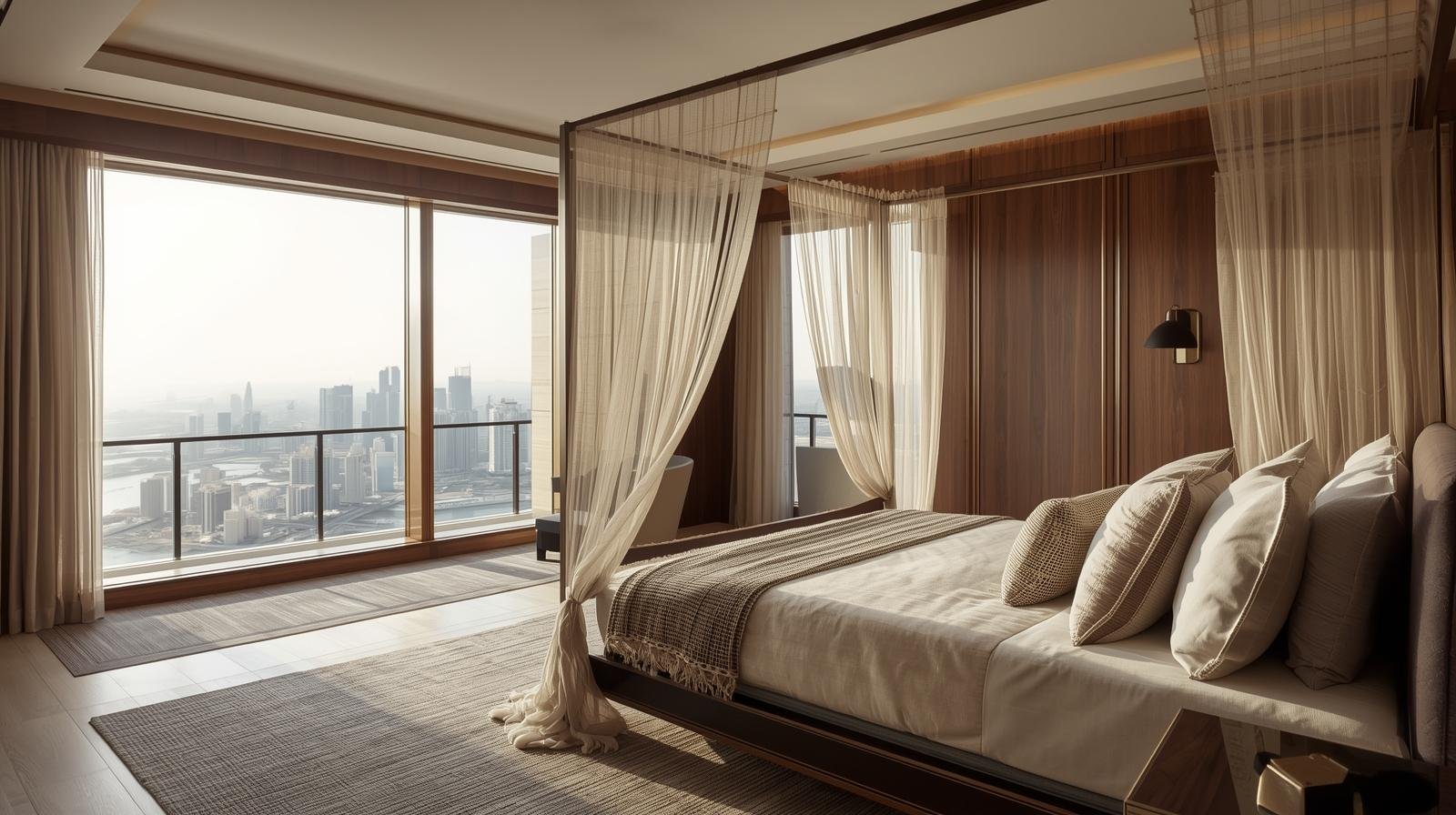
Bedroom textiles mix Italian linens (for sheets and duvet covers) with coverlets woven in Kerala using traditional pit looms. The weavers—working from our color specifications—employed mercerized cotton to achieve subtle sheen. Patterns reference traditional Kerala designs but in contemporary color palettes—charcoal, ivory, warm grey. Each coverlet represents two weeks of weaving.
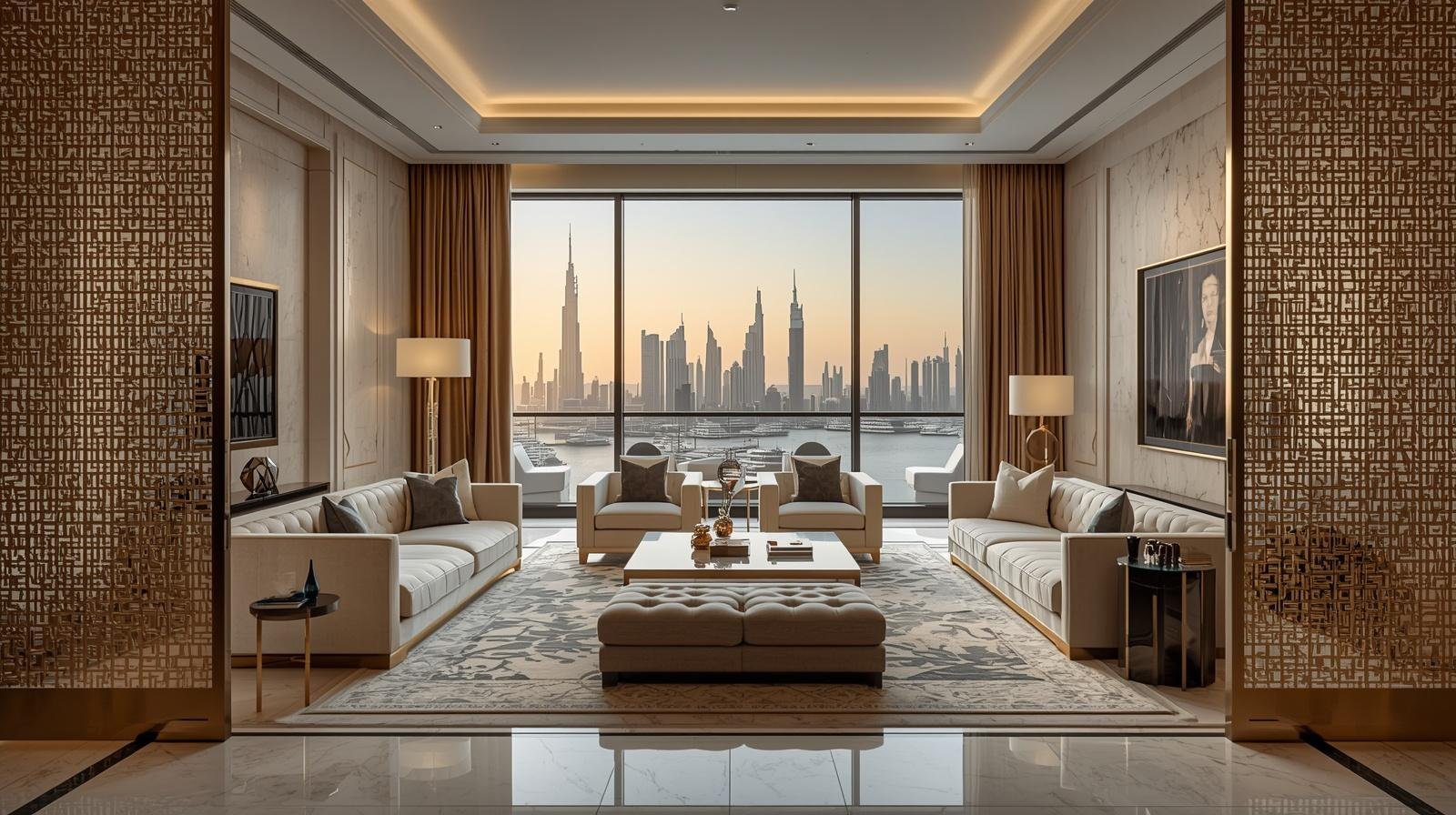
Fifteen months after completion, the apartment has become precisely what the clients envisioned: a space that feels unmistakably theirs while remaining appropriate to Dubai's cosmopolitan context. Friends and visiting family remark on how different it feels from typical Marina apartments—quieter, more grounded, more personal.
The brass screens have exceeded expectations. Beyond their aesthetic contribution, they've proven functionally valuable. The screens filter afternoon sun that would otherwise overheat the space, reducing air conditioning demand. They provide privacy without sacrificing light. Most significantly, they create gradations—allowing the apartment to feel both expansive and intimate depending on vantage point.
The calligraphy studio sees daily use. The wife rises early to practice before her corporate work begins, finding the ritual grounds her regardless of travel schedule. She's begun teaching classes there—small groups of four or five students who gather monthly. The room has become source of creative community in what could otherwise be isolating tower living.
For us, this project demonstrates luxury's potential redefinition. In markets like Dubai, where ostentation often substitutes for quality, we sought to prove that refinement can speak quietly. That cultural identity can express through craft rather than cliché. That the most meaningful luxury is bespoke—not because it's expensive, but because it's precisely calibrated to individual lives, values, and aspirations.
The apartment now appears in Gulf interior magazines, typically described as "contemporary with subtle cultural influences." We find this formulation slightly amusing but essentially accurate. The goal was never to make cultural statement but to create home. That the result feels both contemporary and rooted, both international and specific, both luxurious and humble—this validates our approach more than any accolade.
We collaborate with clients globally who seek interiors that honor heritage while embracing contemporary life. Our process adapts to project location while maintaining craft-first principles.
Begin Conversation