











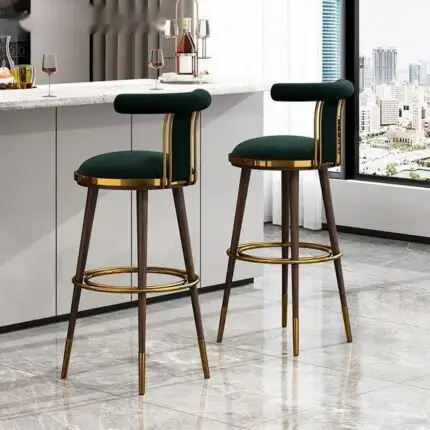
Admire Stainless Steel Bar Chair | Bar Stool | Cafe Designer Chair
Introducing our New Design Wooden Accent Chair – a blend of style and functionality! With dimensions of 40x45x76 cm (LxBxH), this designer dining chair is a statement piece for your dining room. Crafted with care, the wooden chair ensures both chic aesthetics and durability. Choose a natural, or walnut color that seamlessly integrates or boldly stands out, allowing this accent chair to harmonize with your decor. Upgrade your dining experience with this distinctive piece, where modern design meets functionality. Order now to redefine your dining room’s chic ambiance! 🪑✨ #AccentChair #DiningRoom #ModernLiving #DesignerFurniture #HomeDecor
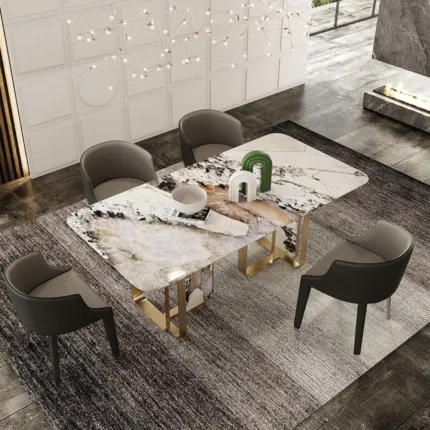
Angus Dining Table Stainless Steel Golden Leg + Natural Marble Top Table
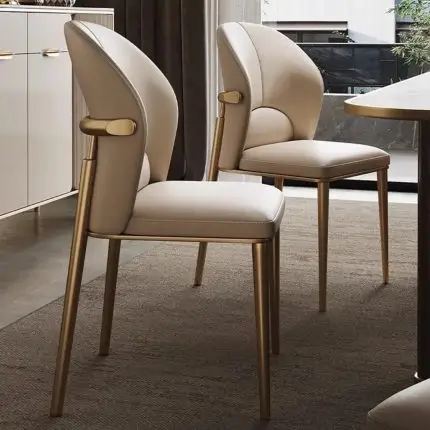
Arthur Dining Chair | Restaurant Chair

Asterix Dining Table Stainless Steel Golden Leg + Natural Marble Top Table
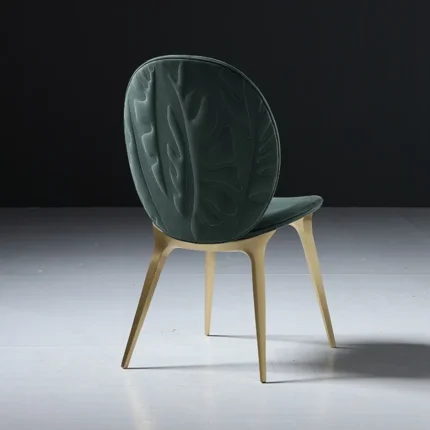
Astrid Italy designer dining Chair

Auralia Sculptural Dining Chair

Bella Sheesham Wood Chair | Dining Chair | Cafe Designer Chair – 4chairs
Introducing our New Design Wooden Accent Chair – a blend of style and functionality! With dimensions of 40x45x76 cm (LxBxH), this designer dining chair is a statement piece for your dining room. Crafted with care, the wooden chair ensures both chic aesthetics and durability. Choose a natural, or walnut color that seamlessly integrates or boldly stands out, allowing this accent chair to harmonize with your decor. Upgrade your dining experience with this distinctive piece, where modern design meets functionality. Order now to redefine your dining room’s chic ambiance! 🪑✨ #AccentChair #DiningRoom #ModernLiving #DesignerFurniture #HomeDecor

Bentley Exclusive Modern Design Dining Chair | Restaurant Chair
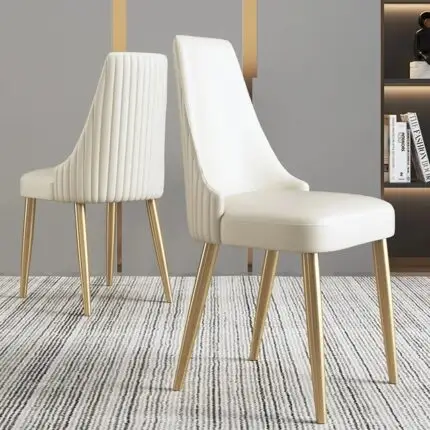
Bloom Dining Chair | Modern Design Restaurant Chair
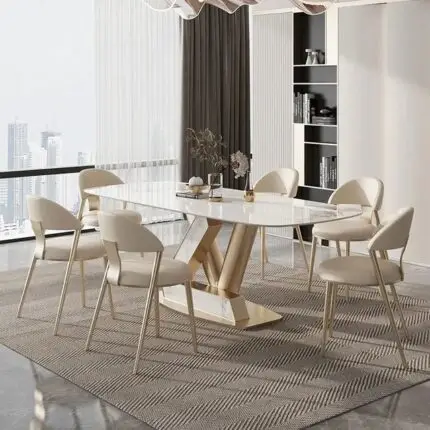
Blush Dining Table Stainless Steel Golden Leg + Natural Marble Top Table

Bride Glen wooden dining chair

Bristol Stainless Steel and Golden Leg Dining Table and 6 chairs Set
Crosby: Your Premier Online Destination for Furniture Solutions
Embark on your journey to transform your living space with Crosby...
For the living room: Explore sofa sets, sectional sofas, lounge chairs...
For the dining room: Elegant dining tables and dining sets...
For the bedroom: Beds, mattresses, wardrobes, children’s furniture...
For the office: Study desks, office chairs...
Outdoor furniture: Tables, chairs & more.
Crosby brings modern styling, comfort, and a quality shopping experience.
Sheesham wood dining tables, chairs and complete dining sets.
Dining room furniture, built to be used
A dining table gets used harder than almost anything else in a house. It takes the weight of a laptop bag dropped without looking, a hot dish set down without a trivet, homework spread across it on a Tuesday and twelve people crowded round it on a Sunday. Most of what goes wrong with a dining set — a wobble that starts in year two, a veneer that lifts at the seam, chairs that were never quite the right height for the table — comes down to the same root cause: it was built to be photographed, not lived with.
We build ours in our own workshop in Erode, Tamil Nadu, which means the table, the chairs and the sideboard in a single dining set come off the same production line, to the same tolerances, by the same joiners. Nothing is bought in from three different vendors and assembled at the last minute. If you've read our note on how the aggregator model works, this is the furniture version of the same argument: when one company designs, cuts and finishes a piece from start to finish, there's one person to hold accountable if something isn't right, and usually nothing goes wrong in the first place.
Everything below is written to help you choose the right table for the room you actually have, not the room in the catalogue photo. If you'd rather just talk it through, our design team will get back to you within a working day.
Sizing a table to the room, not the other way round
The single most common mistake in an Indian dining room is buying the table first and working out the room second. It should go the other way. Before anything else, measure the space and mark out, with tape on the floor if you have to, exactly where the table's edges and the chairs pulled fully out would sit. Ten minutes of measuring saves a return nobody wants to process.
As a rule of thumb, allow about 60 centimetres of table edge per person, and at least a metre of clearance behind every chair so someone can push back and stand without knocking into a wall or a sideboard. That single number does most of the work in deciding what will actually fit.
A two-seater suits a breakfast nook or a compact apartment where the dining area doubles as something else during the day — a fold-down or a narrow console-style table earns its keep here, because it can be pushed back against a wall when it's not in use. A four-seater is the workhorse size for most flats in Delhi, Gurgaon and Noida, comfortable in a room of roughly 3 by 3.3 metres, and it's the size we build and sell the most of. A six-seater needs real intent behind it — you're looking at a room of at least 3.2 by 3.6 metres before the chairs can pull out properly on every side — and it's the size that turns a dining room from a place you eat into a place you entertain. Eight-seaters and beyond belong in independent houses, farmhouses and the larger apartments coming up in Gurgaon's newer sectors, where the dining room is its own space rather than an extension of the living area.
If you're not certain which size is realistic for your room, send us the dimensions through the enquiry form and we'll tell you plainly whether a six-seater will actually work or whether you'll spend three years apologising to guests about the chair that won't push in.
Shape decides how a room feels, not just how many people fit
Once size is settled, shape is the next real decision, and it matters more than most people expect before they live with it.
Round tables are underrated in Indian homes. They make conversation easier because nobody is seated at a corner looking sideways at the person next to them, and they're forgiving of awkward room proportions — a round table reads as smaller than a rectangular one of the same seating capacity, which is exactly why it works well in a squarish room where a long rectangle would eat too much floor. The trade-off is that round tables don't extend as gracefully, so if you expect the guest count to grow occasionally, this is worth thinking through before you order.
Rectangular is still the default for good reason. It seats efficiently, it fits naturally against a wall if the room is tight, and it's the shape every standard chair, bench and sideboard is designed around, so furnishing the rest of the room afterwards is straightforward. Most of our six- and eight-seater tables are rectangular.
Square tables are a genuinely good fit for a squarish room and a four-person household, and they photograph better than people expect — the symmetry does a lot of quiet work. They stop making sense the moment you need six or more seats, because a square table big enough for six starts eating more floor than a rectangle would for the same number.
We also build extendable tables on request — a leaf that lifts out from storage or folds up from beneath the tabletop, taking a table from six seats to eight or ten for the two or three times a year you actually need it. It's a detail worth asking about if you entertain occasionally but don't want a permanently oversized table sitting in a room the rest of the year.
Materials — and why we can be honest about their trade-offs
Because we manufacture rather than resell, we're not trying to move whatever happens to be sitting in a warehouse. We can talk through the real trade-offs of each material rather than simply pointing you at whatever has the best margin.
Solid sheesham is the material most of our dining tables and chairs are built in, and for the Indian climate it's hard to argue against. It's genuinely durable — a well-made sheesham table will comfortably outlast the kitchen it sits next to — and it develops a deeper, richer colour over the first year or two rather than fading. The trade-off is weight: a solid sheesham eight-seater is not a piece you rearrange casually, and it needs a proper felt pad under it if your flooring is a softer stone that could mark under the legs.
Engineered wood with a veneer finish is the sensible middle ground when budget matters more than heirloom durability, or when a design calls for a very flat, seamless surface that solid timber doesn't naturally give you. It's lighter, it's more dimensionally stable in a room with fluctuating humidity, and a good veneer is genuinely difficult to tell from solid wood at arm's length. It won't take the same abuse over twenty years that solid timber will, which is worth knowing going in rather than discovering later.
Marble and sintered stone tops, usually on a stainless steel or brass-finished base, are where we get asked most about maintenance, and it's a fair question. Marble is porous and will stain if a glass of turmeric-stained dal sits on it overnight — it needs a sealant reapplied roughly once a year and a habit of wiping spills promptly rather than leaving them. Sintered stone (sold under names like Dekton or Neolith) gives you the same visual weight with none of the porosity, at a meaningfully higher price. If you want the marble look without the maintenance conversation, that's the honest answer. Our Alps range shows the stainless-and-stone pairing at coffee-table scale, and we build the same language into dining tables on request.
Glass tops, usually toughened and paired with a metal or wood base, suit smaller rooms because they visually disappear in a way solid materials can't — a glass table in a tight room reads as far less imposing than the same footprint in solid wood. They show fingerprints and dust more readily than any other material here, which is a real consideration if wiping the table down twice a day isn't something you want to sign up for.
Chairs, benches, and the seating you actually put around the table
The table gets chosen first almost every time, and the chairs get an afterthought. That's backwards, because seat height, arm height and how a chair tucks under the table matter more to how a meal actually feels than the tabletop finish does.
Standard dining table height in our builds runs 75 to 76 centimetres, and chairs are built to pair at 45 to 46 centimetres seat height, leaving roughly 30 centimetres of clearance under the table — enough for most people to sit comfortably without their knees hitting the apron. If you're mixing chairs from different sources rather than ordering the full set from us, that clearance number is the one thing worth checking before anything else, because a chair that's two centimetres too tall makes a table unusable in a way no amount of styling fixes.
Benches are worth considering on at least one side of a rectangular table, particularly if children are part of the household — they seat more people per linear metre than individual chairs, and they tuck away flush against the table when the room needs to breathe. A bench on the wall side and chairs on the room side is a pairing we build often, because it solves a real space problem rather than just looking a particular way.
Upholstered dining chairs are more comfortable for long meals but need a fabric that can survive a household — a performance weave or a treated leather-look material rather than a delicate cotton. If you're ordering upholstered chairs from us, we'll ask what the household actually looks like — children, a dog, how often the chairs get used — before recommending a fabric, because the wrong answer here is a chair you're afraid to sit in.
Lighting the table properly
A dining table that's beautifully built and badly lit still feels wrong, and lighting is the detail most easily got wrong in an otherwise well-planned room. The rule that actually works: hang the bottom of the pendant 75 to 90 centimetres above the tabletop. Much higher and the light spreads too thin across the table and glares into people's eyes across from each other; much lower and it blocks sightlines and makes the room feel cramped even when it isn't.
For a six-seater or larger, a single large pendant centred over the table reads better than a cluster of small ones — it gives the table a clear visual anchor rather than competing light sources. For a rectangular table longer than about two metres, a linear fixture or two pendants spaced along the length works better than one central light trying to cover the whole span evenly. Our lighting collection has fittings sized for both, and every chandelier and pendant we sell is rewired for Indian 220V with a dimmable driver, because a dining room that can only do one brightness is a dining room that's wrong for breakfast or wrong for a dinner party — never both.
Made to your dimensions, not just the ones in stock
This is the part that's genuinely different about buying from a manufacturer rather than a retailer. If a rectangular table needs to be 20 centimetres narrower to clear a doorway, or a round tabletop needs to be 10 centimetres wider to seat one more person comfortably, we can usually do it — most of our tables can be resized by up to 30 centimetres without a surcharge, because we're cutting to order rather than pulling a fixed size off a shelf. The same goes for finish: a table shown in walnut can usually be built in sheesham or a darker stain instead, and chair upholstery can be specified in a fabric that isn't the one photographed on the website.
If none of what's in the dining collection is quite right — a shape we don't currently list, a size between our standard options, a finish you've seen somewhere else and want matched — tell us through the enquiry form. Custom work goes through the same Erode workshop as everything else we sell, drawn up properly before anything is cut; if you want to understand how we document a piece before it's built, our note on BIM and working drawings explains the process we use for both furniture and full interior projects.
Ordering, delivery and what happens after
Dining sets already in our stock ship in two to four weeks. Anything made to order — a custom size, a non-standard finish, upholstery in a fabric we don't hold ready-cut — takes six to eight weeks, because it's genuinely built after you order it rather than pulled from a warehouse. We'll tell you which category a piece falls into before you commit, not after.
Delivery is free on orders over ₹50,000, which covers most dining sets on its own. Installation — unpacking, assembly, levelling a table that's going onto an uneven stone floor — is handled by our own crew rather than a third-party courier, at no extra charge. All prices on the site are exclusive of GST, charged at the applicable rate on the final invoice.
Frames carry a five-year structural warranty. Hardware — hinges on any extension mechanism, drawer runners on a sideboard — carries ten years, serviced on site by our own team rather than a call centre reading from a script. If you're ordering for a project rather than a single household — a restaurant fit-out, a housing development's common areas, a corporate cafeteria — our trade and bulk ordering page covers volume pricing and lead times at scale, and the full range is also available as a downloadable catalogue if you'd rather work from a PDF than click through the site.
Living with it, year after year
A wood dining table wants a damp cloth for everyday spills and an occasional pass with a wood-safe polish, applied sparingly — more polish is not better, and a heavy silicone-based product will eventually leave a cloudy build-up that's a genuine pain to strip back. Keep any wood table out of direct afternoon sun where you can; UV fading is slow but it's not reversible, and it's the single most preventable damage a dining table suffers over a decade. A felt or cork mat under anything ceramic or metal stops the small scratches that accumulate invisibly until you notice the finish has gone dull in patches.
Marble wants a sealant check once a year and a promise to yourself that spills get wiped within the hour, not the evening. Glass wants a plain glass cleaner and a soft cloth — nothing abrasive, and nothing with ammonia if the frame beneath it is a matte-finished metal, since ammonia dulls matte finishes over repeated use. None of this is complicated, but it's the difference between a table that still looks right in ten years and one that starts looking tired in three.
A few questions people actually ask
Can I mix a table from one collection with chairs from another?
Yes, and we're asked this often enough that it's clearly common practice. The one thing to check is the height pairing described above — as long as the chair seat height and the table height leave proper knee clearance, mixing finishes and styles across a table and chairs works fine, and can look more considered than a matched set bought as one box.
How long does a custom dining table actually take?
Six to eight weeks from a confirmed design and deposit, the same as any other made-to-order piece. A straightforward resize of an existing design is usually at the faster end of that window; a genuinely new design drawn from scratch sits closer to eight weeks.
Do you deliver outside the cities you're based in?
Yes — we deliver and install across India, and separately ship to Ireland, the UK and the UAE for clients working with our international offices. Freight and installation for overseas orders are quoted separately from the piece itself, so nothing is hidden inside a bundled price.
What's the actual difference between your tables and what's available through a retailer?
Mainly that we can change things. A retailer sells you the size, shape and finish that's already been manufactured and is sitting in a warehouse somewhere. We're cutting to order in our own workshop, which is why resizing, refinishing and custom seating counts are all things we can say yes to rather than pointing you at a slightly different product instead.
If you've read this far and still aren't sure what will actually fit your room, that's a completely normal place to be before buying a dining table — it's a big decision. Send us the room dimensions and what you're hoping to use the space for, and we'll tell you plainly what will and won't work, before you spend anything.

 Bedroom


